Many Wonderful Works

"Cause me to know the way
wherein I should walk;
for I lift up my soul unto Thee."
(Ps. 143:8)

Perhaps the most significant role of the Word of God is that it inerrantly reveals to us the nature of its Author. Although Creation points to a Creator (Ps. 19:1) and our conscience bears witness that "sin is a reproach" (Prov. 14:34), apart from the Scriptures we have no "knowledge of salvation" and are unable "to be saved, and to come unto the knowledge of the truth" (Luke 1:77; 1 Tim. 2:4). As N. A. Woychuk points out in Thus Says the Lord, "There is only one way to heaven, but there are many secret paths that lead to hell." The only way to avoid these "secret paths" of destruction is to know "know Him that is true. . .even in His Son Jesus Christ. This is the true God, and eternal life" (1 John 5:20).

Of course the Scriptures not only reveal the commandments of God; they also reveal the power of God and His many "wonderful works" (Ps. 40:5). The parting of the Red Sea points to the omnipotence of Him who promised, "When thou passest through the waters, I will be with thee" (Isa. 43:2). The preservation of Daniel in the lions' den undeniably confirms that "with God nothing shall be impossible" (Luke 1:37). The cleansing of the leper attests the ability of Christ to also "forgive us our sins, and to cleanse us from all unrighteousness" (1 John 1:9).

We also see the faithfulness of God revealed in the promise that He "will not suffer you to be tempted above that ye are able" (1 Cor. 10:13); the justice of God manifested in the suffering of "the just for the unjust, that He might bring us to God" (1 Pet. 3:18); the holiness of God declared by hosts of angels (Rev. 4:8); and the love of God demonstrated "in that, while we were yet sinners, Christ died for us" (Rom. 5:8).

Few things affect your relationship with God more than your perception of Him. The Scriptures accurately reveal the nature of God and make it possible for us to enjoy "the fellowship of His Son, Jesus Christ our Lord" (1 Cor. 1:9). And while it may indeed be possible to know the truth and willingly "reject the word of the Lord" (1 Sam. 15:23), walking daily in the "path of life" (Ps. 16:11) is only possible to those who sincerely pray with the Psalmist, "Order my steps in Thy word: and let not any iniquity have dominion over me" (Ps. 119:133).

The Rock That is Higher Than I

20150912_111034 (2)

"For I am the LORD,
I change not;
therefore ye sons of Jacob
are not consumed."
(Malachi 3:6)

I write these words on a breezy Missouri morning, as I enjoy the view from the peak of Taum Sauk Mountain - the highest point above sea level in my home state. My laptop is at home. My cell phone is turned off, and the only thing distracting me from writing is a sky of billowing clouds and a horizon met by rolling hills.

As I reflect on the twelve months that have passed since I last visited this mountain, to say much has changed in my life would be an understatement. In a way, I've climbed many mountains of my own during that time, and my vision of the future was often obscured by a fog of uncertainty. God's love, grace, and provision was stretched out before me, but I rarely took time to enjoy the view.

As I consider Paul's exhortation to "walk by faith, not by sight" (2 Cor. 5:7), I have to believe he was looking ahead to times when faith would be his only strength to keep walking. He knew days would come when it would be hard just to put one foot in front of the other, and that failure would be certain if his continued walk depended on favorable circumstances. And so he resolved not to walk by sight, but entirely "by the faith of the Son of God" (Gal. 2:20).

David's prayer in Psalm 61:2 was simple: "From the end of the earth will I cry unto Thee, when my heart is overwhelmed: lead me to the rock that is higher than I." The visitor to this mountain may be subject to change and sometimes overwhelming circumstances, but the Maker of the mountain remains steadfast, unmoving and unchanging through it all.

Lessons from the Life of Job

"There was a man in the land of Uz,
whose name was Job;
and that man was perfect and upright,
and one that feared God, and eschewed evil."
(Job 1:1)

Many scholars agree that Job is probably the oldest book of the Bible. It seems appropriate, then, that the oldest portion of Scripture immediately addresses the age-old question, "Why do bad things happen to good people?"

Job is introduced to us as a very wealthy man (1:3), and one that God Himself regarded as "perfect and upright." His net worth in modern currency could have exceeded $5,000,000, which makes his morality all the more remarkable. After all, how many present-day millionaires "hold fast their integrity" (2:3) as Job did? And yet even when he lost everything, Job's heart-cry seemed to be very much in line with Paul's in Acts 20:24, "None of these things move me, neither count I my life dear unto myself, so that I might finish my course with joy . . .to testify . . . of the grace of God."

Most of us have been encouraged by Job's story at some point in our lives. Here was a man who had what many people spend their entire lives striving for: money, friends, family, and plenty of possessions. He achieved his culture's version of the American Dream, and yet his first priority was never keeping up with the Joneses; it was walking with his God.

Of course we all know the story of what happened next. In a matter of moments, nearly everything Job claimed as his own was stripped away. The most tragic loss was that of his children:

"...there came also another, and said,
Thy sons and thy daughters were eating
and drinking wine in their eldest brother's house:
And, behold, there came a great wind from the wilderness,
and smote the four corners of the house,
and it fell upon the young men, and they are dead."
(Job 1:18-19)

That's when Job realized this was more than just a bad day. The Lord Himself had indeed "put forth His hand, and touched all that he had" (1:11). In what had quickly become the darkest moment of his life, Job was understandably overwhelmed with grief. He tore his clothes, shaved his head, and collapsed to the ground. And yet even as he faced circumstances that would no doubt be unbearable for many of us, Job looked to heaven and cried out, "the Lord gave, and the Lord hath taken away; blessed be the name of the Lord" (1:21).

In the days that followed Job lost his health, the support of his wife, and eventually that of his closest friends. But as he sat among the ashes scraping his boils with a piece of broken pottery, he asked rhetorically, "What? Shall we receive good at the hand of God, and shall we not receive evil?" (2:10).

What astounds me about Job's spiritual strength is that it doesn't seem to be something he acquired during his trial like most of us. His acceptance of God's sovereignty was immediate, not eventual. Here was someone who had figured out during the good times what many of us are forced to learn in the bad times: that God is all we really need. He held everything loosely, except for his relationship with God.

You may never face a valley as dark as Job's. You may always (or never) be blessed with good health, financial security, and supportive family and friends. Either way, remember that Job's story is not about a man who lost everything, but about a man who found everything he needed in God. When everything and everyone else in his life proved unreliable, he found his strength in the everlasting arms of the Lord (Deut. 33:27).

Against Hope, Believe Hope // Lost Loved Ones

“Who against hope believed in hope,
that he might become the father of many nations;
according to that which was spoken,
So shall thy seed be.”

(Romans 4:18)

Today I experienced the familiar frustration of misplacing the belt clip for my cell phone. Yes, I know they're pretty uncool but, in keeping with my personality, I use one anyway. And although I’m generally an organized person, I’ve found myself searching for this conspicuous accessory more times than I’d care to admit.

So there I was, searching diligently from room to room with no immediate luck. I had errands to run and was becoming annoyed by the delay, but I wasn't leaving the house without it. As I searched, Luke 15:8 came to my mind:

“Either what woman having ten pieces of silver,
if she lose one piece, doth not light a candle,
and sweep the house,
and seek diligently till she find it?”

When something valuable is lost, and when finding it proves difficult, there are generally two ways in which we can choose to respond: 1) concede that it's probably gone forever, or 2) search harder. In this case, the inconvenience of searching was outweighed by my hope of finding something I valued.

The majority of us have a long list of loved ones in desperate need of Christ - sons, daughters, neighbors, and coworkers who are spiritually lost, "having no hope, and without God in the world" (Eph. 2:12). Perhaps some of them are even backsliders who "were once enlightened, and have tasted of the heavenly gift, and were made partakers of the Holy Ghost, and have tasted the good word of God, and the powers of the world to come" (Heb. 6:4-5). You've witnessed to them faithfully and prayed for them tearfully, but nothing has changed. The "search" thus far has been exhausting and unsuccessful.

This is the point where many people give up. They resign themselves to the sad conclusion that what is lost will never be found, that the prodigal who has "departed into a far country" will never again "come to himself" and return home (Luke 15:13, 17).

But all hope is not lost! After all, we've been given the blessed promise from God that "if we ask any thing according to His will, He heareth us," and certainly He is "not willing that any should perish, but that all should come to repentance" (1 John 5:14; 2 Pet. 3:9). Your prayers are being heard. Your tears are seen by the "Father of mercies, and the God of all comfort," Who offers us the consolation that "they that sow in tears shall reap in joy" (2 Cor. 1:3; Ps. 126:5). Not only is He deeply "touched with the feeling of our infirmities", but He "is able to do exceeding abundantly above all that we ask or think" (Heb. 4:15; Eph. 3:20).

So keep praying, keep witnessing, and most importantly, keep believing. Live every day walking by faith (2 Cor. 5:7), rejoicing in hope (Rom. 12:12), and resting in Divine love (Zeph. 3:17). The answer may be just around the corner.

Give Me Faith

“I need You to soften my heart and break me apart
I need You to open my eyes, to see that You're shaping my life
All I am, I surrender

Give me faith to trust what You say,
That You're good and Your love is great
I'm broken inside, I give You my life

I may be weak but Your Spirit's strong in me
My flesh may fail, but my God You never will”

           (Give Me Faith - Elevation Worship)

I know I usually open my posts with a Scripture, but this song has been resounding loudly in my soul all day long. My heart has been overwhelmed with just about every type of emotion over the last two weeks, and the chorus of this song is a prayer I just can’t seem to get away from: “give me faith.”

As someone who devotes much of my time to various forms of ministry and trying to convince others of the love and goodness of God, it feels awkward to admit that I’ve had to continually pray for Divine reminders of these things. After all, they’re two of the most basics aspects of Christianity. Yet I think it’s because they are in fact so fundamental that Satan makes a special effort to convince us that God is either impressed by our strength or ashamed of our weakness. When we don’t fully believe that God’s love is unconditional and that His grace is free, we inevitably exhaust ourselves trying to earn what we so desperately need.

It’s true that faith and doubt are complete opposites by definition, but I think they often share close quarters in the secret places of our hearts. Even Peter, who had enough faith to step out of a boat onto raging waters with Christ, was overwhelmed by doubt and fear just seconds later and began to sink (Matt. 14:30-31). It’s as if the disappointment we feel every time the love of the world fails keeps us from ever fully trusting in a love that cannot fail.

But God isn’t the earthly father that turned his back on you; He’s your heavenly Father Who imparts “the Spirit of adoption, whereby we cry, Abba, Father.” (Rom. 8:15) He isn’t a fair-weather friend who doesn’t have time for your problems; He’s “a friend that sticketh closer than a brother.” (Prov. 18:24) Your boss may capitalize on every opportunity to criticize your mistakes, but the strength of Christ is perfected in weakness and depravity (2 Cor. 12:9-10). He doesn’t hold your humanity against you; He delights in you as His child and “will joy over thee with singing.” (Zeph. 3:17)

You don’t have to make God aware of your fears. He already knows what troubles your mind and burdens your heart. Pray for faith to believe that you really are the object of the greatest love that has ever existed, and that you be made “confident of this very thing, that He which hath begun a good work in you will perform it until the day of Jesus Christ.” (Phil. 1:6)


Grace – The Riches of His Goodness

Untitled-1“Being justified freely by His grace through the redemption that is in Christ Jesus.”
(Romans 3:24)

I'm someone who generally tries very hard to think as logically and as rationally as possible. Even though I was taught to believe the Bible since I was very young, my commitment to God is based on a personal certainty that Christianity just makes sense. For example…

  • My conscience confirms that sin is wrong; the Bible defines sin and its consequences (1 John 3:4; Rev. 20:15).

  • The beauty of nature points to a divine Maker Who is described in Isaiah 40:28 as "the Creator of the ends of the earth."

  • Thousands of Biblical prophecies have been irrefutably fulfilled in exact detail, and many last-days prophecies are continuing to unfold.*

Despite what anybody says, you don’t have to commit intellectual suicide to become a Christian. In fact, to fully know the truth is impossible without becoming personally acquainted with Jesus, “the Way, the Truth, and the Life.” (John 14:6)

Of course there are some aspects of the Gospel that no human mind can fully comprehend. The underlying principles of grace and unconditional love defy human logic altogether – especially when you consider that we are offered so much more than salvation from hell. The Son of God Himself stands at the door of our hearts, offering a relationship that will radically transform every moment of the rest of our lives (Rev. 3:20).

If this doesn’t astound you, consider Paul’s analysis of grace in 2 Corinthians 8:9,

“For ye know the grace of our Lord Jesus Christ,
that, though He was rich, yet for your sakes He
became poor, that ye through His poverty might be rich.”

Even though God’s grace cannot possibly be matched by human generosity, imagine passing a stereotypical homeless person on the street who asks you for money. You could brush him off like most people, or give him $10 and feel proud of yourself for the rest of the day. Would you even consider withdrawing every penny from your bank account and handing over your life savings? Would you volunteer to take his place sleeping under the bridge and sign over the title to your house? Hypothetically speaking, would you trade your good health for tuberculosis and frostbite?

Probably not – and yet that’s only an imperfect picture of the grace of God. According to Isaiah 53, He alone “bore our griefs and carried our sorrows.” (Vs. 4) When we had “turned every one unto his own way”, the Father “laid on Him the iniquity of us all.” (Vs. 6) Our redemption was fashioned through the gruesome crucifixion and marvelous resurrection of Him “Who knew no sin; that we might be made the righteousness of God in Him.” (2 Cor. 5:21)

No matter how hard I try, I can’t make sense of the grace of God. It goes completely against the grain of human/Adamic nature that mixes ulterior motives of selfishness and pride with nearly everything we do. But even though it may not seem logical, God’s grace is a very real extension of His immeasurable love for humanity. It’s absolutely undeserved and yet completely free.

*http://www.reasons.org/articles/articles/fulfilled-prophecy-evidence-for-the-reliability-of-the-bible

Remembering Redemption

"He will turn again, He will have compassion upon us; He will subdue our iniquities; and Thou wilt
cast all their sins into the depths of the sea."
(Micah 7:19)

As Christians, we often speak of God's "sea of forgetfulness." We rejoice in the grace and forgiveness of God, and for very good reason. Aside from the fact that He "hath not dealt with us after our sins, nor rewarded us according to our iniquities", we can take comfort in knowing that the Master of creation is on our side and counts us as beloved children He has "bought with a price." (Ps. 103:10; Rom. 8:31; 1 Cor. 7:23)

Simply put, our redemption is an invaluable gift and one that we should keep in constant view. Our attitudes and actions should be influenced above all else by the realization that we are among "they which are written in the Lamb's book of life." (Rev. 21:27)

But equally as important as recognizing who you are in Christ is remembering who you were before Christ. Let's take a look at Paul's assessment of our spiritual state before salvation:

"And you...were dead in trespasses and sins."
(Ephesians 2:1)

Contrary to common illustrations that depict man as drowning or dying in sin, the reality is that we were already dead, buried in the grave of wickedness. The thief had stolen, killed and destroyed, leaving us spiritually lifeless and morally corrupt (John 10:10). Our tombstone was engraved with the ominous epitaph: "there shall be weeping and gnashing of teeth." (Matt. 8:12) As Paul continued in verse 12, we were "without Christ...having no hope, and without God in the world."

To say we needed help would be a serious understatement; we needed miracle, and a miracle is exactly what we got:

  • We were dead, “but God, who is rich in mercy…hath quickened us together with Christ.” (Eph. 2:4-5)

  • We were “children of wrath” who are now called “children of God by faith in Christ Jesus.” (Eph. 2:3; Gal. 3:26)

  • Our “unclean lips” have tasted and seen that the Lord is good (Isa. 6:5; Ps. 34:8).

True life is found only in knowing Christ (John. 17:3). If you’ve accepted God’s gift of salvation and eternal life, never forget where you came from or the price that was paid for your soul (Rom. 6:23). Instead, take a moment today and “look unto the rock whence ye are hewn, and to the hole of the pit whence ye are digged.” (Isa. 51:1) It may be God has brought you further than you think.

Blogging Bible Bits

Capture

If you’re reading this, then chances are you already know that writing has been a part of my life for many years now. And despite the fact that I’ve not been especially active in the blogosphere over the last 12 months (sorry!), I've often felt that my ministry would involve a commitment to writing on a regular basis.

Another aspect of my life you may or may not be familiar with is that I'm a firm believer in the importance of Scripture memorization. Scripture Memory Fellowship, a ministry that has been instrumental in my own spiritual life over the years, is one of few organizations dedicated solely to the practice and principle of memorizing Scripture, and I've been honored by an invitation to serve as a weekly contributor to their brand new website which debuted today: www.scripturememory.com.

In case you're unfamiliar with the ministry of SMF, our goal is a simple one: to get God's Word into people's hearts systematically. We have a variety of resources available, including memory books which organize verses by topic, and audio CD's with whole chapters set to music. My blog posts will point to these resources when appropriate, as well as highlight other methods of Scripture memorization I have found to be effective.

To be clear, this does not mean I’m discontinuing my posts here. In fact, as I return to writing on a regular basis one of my goals is to publish more devotional materials right here at A Look at Life from Deerstand. I’m simply sharing this news in hopes that you'll take a few minutes to look around the new site and send me any feedback or questions you may have. I'd also be interested in knowing what you'd like to see written about on the blog.

Please check back often and, as always, keep in touch!

NOTE: If you’d like to purchase any Scripture memory tools from the website, be sure to use the coupon code “welcome” during your checkout for 20% off through 11/30/14.

No More Pretending

“Confess your faults one to another, and pray one for another, that ye may be healed. The effectual fervent prayer of a righteous man availeth much.”
-James 5:16

Our culture is one that glamorizes perfection. If you're not sure what I mean, just turn on your T.V. or take a trip to the mall. Commercials tell us we're incomplete without the latest and greatest gadgets. Photoshopped supermodels tell us what we should wear. The car that just passed you on the highway was newer than yours. In some way or another, we are confronted on a daily basis by the lie that our shortcomings are unacceptable.

But the truth of the Gospel is that God sees our shortcomings as opportunities to lavish us with His grace. Paul put it this way in 2 Corinthians 12:9-10,

"And He said unto me, My grace is sufficient for thee: for My strength is made perfect in weakness. Most gladly therefore will I rather glory in my infirmities, that the power of Christ may rest upon me."

"Therefore I take pleasure in infirmities, in reproaches, in necessities, in persecutions, in distresses for Christ's sake: for when I am weak, then am I strong."

Take a moment to reread these verses and fully grasp what Paul is trying to teach us here. He's saying our weakness is not only acceptable, but it is actually a glorious thing when placed in the hands of our loving Savior. We don't have to have everything together emotionally, financially, or even spiritually - which is a good thing for people like me. Instead, Paul insists that our inadequacies can actually bring glory to God when we allow the power of Christ to “rest upon us”. This means abandoning our own tendency to "just try harder" and allowing the strength and grace of Jesus to reign over every aspect of our lives. As in Paul’s case, this could mean learning to live with a “thorn in the flesh” that God chooses not to remove for reasons we may never understand (2 Cor. 12:7).

My experience over the last several months, however, has been that viewing my own weaknesses through the lens of grace is much easier said than done. Even though most Christians I know would agree with everything I've written so far, it seems that most believers, including myself, are obsessed with convincing everyone else they've got it all together. We try to look perfect every Sunday morning and play the part of a Type A Christian, while on the inside a majority of us are battling doubt, fear, and/or depression on some level.

How do I know this? Because I’ve seen too many people who played the part of Super Saint simply give up without warning. Everyone thought they were happily married until he left. No one knew she was depressed until she attempted suicide. He never talked about his doubts until he quit going to church. People who played the part perfectly week after week were entrenched in the greatest spiritual battles of their lives, but were too afraid of condemnation to reach out for help.

Do you see the resemblance yet? While pop culture is telling us how many Instagram followers we should have, the church world is setting its own standards of spiritual excellence. If you need just one more friend on Facebook, you might be tempted to accept that request from someone you may or may not have passed in Walmart last week. If you lack a little faith in God, pretending to be stronger than you really are is usually easier than admitting your doubt, especially when you’re convinced no one else will relate to your struggle.

The only problem with this masquerade of perfection is that it’s just that: a masquerade. Somewhere along the line we tend to lose sight of our daily need for grace and then exhaust ourselves trying to impress God and everyone else with our faithfulness. We’ll request prayer for a sick relative or a lost family member, but dare not admit our own discouragement for fear of appearing weak. We try to measure up to standards of commitment set by other believers, not realizing that many of them are playing their own small role in this charade.

What's so wrong with this type of Christianity is that it effectively "sets aside the grace of God" (Gal. 2:21) in one's relationship with the Lord and his relationship with fellow believers. And a life devoid of grace is hardly worth living.

"Are ye so foolish? having begun in the Spirit, are ye now made perfect by the flesh?"
-Galatians 3:3

Despite my own propensity to overcomplicate things, I have arrived at the conclusion that the key to victory in almost every battle one can possibly face is simply to trust in God's love and grace, to lean on the “rock that is higher than I” (Psalm 61:2). Paul's point in Galatians 3:3 is very clear: grace is what saved us and grace is what keeps us going. To the extent that we trust in our own strength we are prone to failure, but when we cast our burdens upon the Lord it becomes evident that only He can sustain us (Psalm 55:22).

The Danger of Exclusiveness Among Christians

In many ways this is a post I never thought I would write. It’s not that my beliefs have changed at all over the last several months, but for most of my Christian life I’ve been the kind of guy who defends what I like to call “absolute truth.” Relativism – the idea that absolute truth does not exist – is a worldview entirely incompatible with Christianity, but one that seems to be common even among some professing Christians. With that said, exclusivity is not a bad word; in fact, it’s Biblical to some extent.

“Pilate saith unto him, What is truth? And when he had said this, he went out again unto the Jews, and saith unto them, I find in him no fault at all.”

                 John 18:38

Within every person is a desire to know truth. Not everyone likes the truth once they find it, but nobody intentionally lives for a lie. Whether you’re a devout Christian or a loyal atheist, your commitment comes from the underlying belief that you are right. I’ve seen evolutionists invent evidence to support their worldview, and I’ve known Christians who misquote Scripture or use it out of context as “proof” that their beliefs are accurate. They could just as easily decide to believe what they want independently of the facts, but human nature means we all hate the idea of being wrong.

In a world and culture saturated by evil and false doctrine, some level of exclusivity among Christians is healthy. For example, we must assert that Jesus Christ is the one and only way to heaven (John 14:6), that the virgin birth is a reality, and that His death and resurrection really occurred. Certain issues like these are simply not up for debate, as John indicated in his second epistle. According to verse 10, if any person “abideth not in the doctrine of Christ”, especially by denying the reality of His first coming, they should not even be welcomed into our homes.

Beloved, when I gave all diligence to write unto you of the common salvation, it was needful for me to write unto you, and exhort you that ye should earnestly contend for the faith which was once delivered unto the saints.

                                  -Jude 1:3

Too many Christians, however, extend this principle to every aspect of their spiritual lives. They leave churches or look down on fellow believers over things like predestination and Sabbath keeping. They argue about whether the rapture will be pre-, mid-, or post-millennial. Your time reading the Bible each day doesn’t even count unless you’re using their favorite translation. I understand there are definite truths at stake in each of these debates, but at some point all but excommunicating fellow believers for their differing beliefs does more harm than good – both to their walks with God and ours.

“Neither pray I for these alone, but for them also which shall believe on me through their word;
That they all may be one; as thou, Father, art in me, and I in thee, that they also may be one in us…”

                                        -John 17:20-21

We understand that apostasy is and will continue to be prevalent in the last days (II Tim. 4:3). It is for this reason that we must “watch and pray” lest we enter into temptation ourselves (Matt. 26:41). But since God’s ultimate desire for His saints is that they experience unity, we must be careful not to undermine His divine work by looking down on everyone who’s understanding of Scripture is slightly different than ours. Why? Because such an attitude is devastating to the individual Christian’s spiritual life: not only will it discourage those who “aren’t good enough”, but it typically isolates the supposed “elite” Christian from the fellowship of other believers. Let us instead learn to live by the words of Paul in Romans 14:

[4] Who art thou that judgest another man's servant? to his own master he standeth or falleth. Yea, he shall be holden up: for God is able to make him stand.

[7] For none of us liveth to himself, and no man dieth to himself.

[8] For whether we live, we live unto the Lord; and whether we die, we die unto the Lord: whether we live therefore, or die, we are the Lord's.

[10] But why dost thou judge thy brother? or why dost thou set at nought thy brother? for we shall all stand before the judgment seat of Christ.

[12] So then every one of us shall give account of himself to God.

[13] Let us not therefore judge one another any more: but judge this rather, that no man put a stumblingblock or an occasion to fall in his brother's way.


rZnzL

99% – Part 1: Fully Persuaded

Commitment never exceeds assurance. In fact, by simply examining a person’s devotion to a particular ideal, you can usually gain an accurate understanding of just how much they do (or don’t) believe in it. A Christian who still occasionally wonders about the divine inspiration of Scripture, or secretly doubts whether God actually exists, will never be fully committed to his faith or have much success in convincing others he’s found the truth.

“He staggered not at the promise of God through unbelief; but was strong in faith, giving glory to God;
And being fully persuaded that, what He had promised, He was able also to perform.”

                    -Romans 4:20-21

Several years ago when God called me to preach, I remember a period of one or two days when I felt about 99% sure of my calling. Of course there are some areas of life when that level of certainty is sufficient, as we discussed last week. Would you hesitate to schedule a picnic on a day with a 99% chance of sunshine? Of course not. But I recognized that a call to the ministry carries with it much more significance than a day at the park. It’s a permanent calling and one that would require my daily attention.

Sure, 99% would have been enough at first. I would still have been able to preach my first sermon with enthusiasm and gladly accept any invitations to speak at local churches. But what about when things got rough? What about the times I faced criticism for my beliefs, or felt my service wasn’t being appreciated? Suddenly that small bit of doubt would have occasion to grow, and the devil would likely succeed in convincing me that I misunderstood the Lord in the first place.

With this in mind, I told God I needed absolute assurance that the voice I heard was in fact His. It took several more hours of prayer and soul searching, but I came away without any doubt of what God had called me to be.

Of course not everyone reading these words has been called to this same type of ministry, but you still need a relationship with God that is free of doubt and uncertainty. 99% may be enough for you today when everything is going well spiritually. But sooner or later, you’ll go through the fire. Your faith will be put to the test, and any doubts you have now will only grow then. Let today be the day you let God erase any doubts hidden deep in your heart and replace them with His truth.


99% – New Series Introduction

You’ve seen the ads. Chances are you’ve bought the products. Air fresheners, disinfectant wipes, and…well…99% of cleaning products on the market generally make the same claim: they’ll kill 99% of germs, 100% of the time. The question is whether or not 99% is good enough, and the answer inevitably depends on the context of the claim.

For example, a police department that successfully solved 99% of local crimes would be doing pretty good, as would any doctor that managed to send 99% of cancer patients into remission. For all intents and purposes, a bottle of hand sanitizer that sterilizes 99% of the germs on my hands is worth the money.

But there are as many scenarios when 99% is simply unacceptable. What if a hospital advertised a 99% success rate when it came to giving the right baby to the right mother? What if credit card companies charged only 99% of purchases to the right account, or your bank properly processed only 99% of transactions? Chances are it wouldn’t take an expensive advertising campaign for these inadequacies to become public knowledge.

On a more personal level, would you be satisfied in knowing your spouse was 99% sure he/she loved you? What if 1 John 4:8 read, “He that loveth not knoweth not God; for God is mostly love?” Suppose the Word of God Itself claimed only to be 99% accurate? Chances are you would be hesitant to invest your life in a relationship if you weren’t entirely sure your feelings were reciprocated, or to follow God wholeheartedly if you thought there was a chance He didn’t exist.

In the same way, serving God is one of the many areas of life that requires absolute commitment. It’s not difficult to fill the majority of one’s time with godliness. You may attend church Sunday morning, listen to Christian music on your way to Cracker Barrel afterwards, and engage in Christian conversation around the table. But if you refuse the Lord’s leading to share the Gospel with the waitress, you successfully filled roughly 99% of your day with God but came up short when it mattered most. As the apostle Paul would have said, a little leaven leavened the whole lump (Gal. 5:9).

Over the next several weeks, we’re going to take an in-depth look at the difference between partial commitment and complete devotion. The differences may not always be obvious, but they are nevertheless important and often carry with them eternal consequences – both for you and those you influence.

Part 1 is scheduled to go live one week from today, so check back on Sunday or subscribe via email to make sure you don’t miss it. In the meantime, please leave a comment or shoot me an email with your thoughts or favorite Bible verses on the subject.


Get Over It – Dealing With Anger Through Forgiveness

“An angry man stirreth up strife, and a furious man aboundeth in transgression.”

       -Proverbs 29:22

Everybody knows what anger feels like. When someone lies to you, cuts you off in traffic, or is five minutes late for a dinner appointment you immediately feel it starting to build. But just because anger often comes so naturally when things don’t go your way doesn’t mean this emotion is always justified. Even if we are quite certain that we have every right to our anger, the question then becomes “is it worth it?” Studies show angry people are more likely to experience heart trouble, headaches and weakened immune systems1, not to mention the emotional and spiritual side effects.

“But Jesus got angry!” you may be saying. Yes, but Jesus’ anger was far different than what we usually experience. In his book “Anger is a Choice”, Tim LaHaye makes this point:

“It is wrong to compare our Lord's anger toward sin with human anger, for Jesus has a divine nature of holiness that man does not share; thus Jesus could sustain a holy wrath without sin. His most severe anger involved righteous indignation against sin; it was never a response to personal rejection, insult, or injury.”

Reading this for the first time awakened me to the foolishness of comparing my anger to God’s, or attempting to justify resentment based on Christ’s occasional righteous indignation toward the Pharisees. I’ve heard many believers point to the Lord’s cleansing of the temple in John 2 as “evidence” that their own anger toward a friend or family member is reasonable, without considering that Christ never took personal offense. Is there any record of a heated argument with Peter after his denial of the Lord? Did He harbor a grudge against Judas, or any of those who crucified Him? Quite the opposite! In fact, Scripture indicates His immediate prayer was for their forgiveness (Luke 23:34). It didn’t take Him years of battling with bitterness and hatred before He found peace; He never gave place to anger in the first place. 

“But if ye forgive not men their trespasses, neither will your Father forgive your trespasses.”

       -Matthew 6:15

The obvious cure for anger is forgiveness, and forgiveness never comes without sacrifice on your part. For example, forgiving someone who stole $10 from you means releasing your claim to that money and shouldering the financial consequences of another’s actions. Forgiving someone for tainting your reputation with gossip means bearing the loss of your good name. Basically, any instance of forgiveness requires you to give up your claim to restitution. Isn’t that what Christ did for us? He released us from the consequences of our sin, but only because He personally paid the price for them.

In the parable of the king, one generous ruler forgave his servant of an enormous debt equivalent to millions of dollars in today’s money. The former debtor then went out and found someone who owed him 100 pence, – about $10 – took him by the throat, and demanded payment (Matthew 18:23-30). Forgiveness was not given as it had been received, and anger was the result.

Don’t allow your life to be consumed with anger. It is perhaps the greatest thief of Christian joy you’ll ever encounter, while the extension of forgiveness to the undeserving is one of the greatest sources of this joy. Let your joy be full.


1 http://www.webmd.com/balance/stress-management/features/how-anger-hurts-your-heart
http://theycallmewahmmy.com/can-anger-make-you-sick/

Book Review: “The Great House of God”

Book Cover

I can’t recall ever reading a book by Max Lucado and feeling disappointed by the overall quality and clarity of his work. The only disappointment is when the final page is turned and the last paragraphed read, and “The Great House of God” was able to both meet and surpass every expectation I had.

Max does a phenomenal job examining every portion of the Lord’s prayer which, as you will recall, spans only five verses of the Word of God. And yet despite the actual passage’s relative brevity, I was captivated by 240 pages of highly-visual language. As he points out, the Lord’s prayer is more than a set of eloquent words to be recited; it is a promise to be trusted. Furthermore, it lays the groundwork for what he calls The Great House of God: we can find fellowship in the family room, nourishment in the kitchen, and a reminder of our Father’s majesty in the chapel. The best part of all is that we have not merely been invited to this place for a short visit, but we are called to take up permanent residence in the home of our Creator.

The prayer of David in Psalm 27:4 was simple: “That I may dwell in the house of the LORD all the days of my life, to behold the beauty of the LORD.” If this is not currently your prayer, then certainly “The Great House of God” will convince you that it should be. Even if at this moment you feel no need for encouragement and are already dwelling this magnificent house, still consider picking up a copy of this worthwhile read. Perhaps it will open the doors to rooms you didn’t know existed.

My Rating: 5/5 Stars


Disclaimer: I received this book free from the publisher in exchange for my honest review. I was not required to write a positive review and all expressed opinions are my own.

My Week in Review: Music, Encouragement, Jesus

Concert Photos

Needless to say, the last three days have been pretty spectacular. Thursday I had the opportunity to meet one of my favorite worship leaders, Kristian Stanfill, and enjoy front row seats during his concert. Yesterday was a night of worship with Chris Tomlin, Kari Jobe, and Louie Giglio, and tonight Phil Stacey (former American Idol finalist) will be playing at a local church about 15 minutes from my home. I typically don’t attend more than one or two concerts a year, but when a handful of my favorite artists come to town within a four day time span I find it hard to resist.

Voice of the Martyrs Charity Auction

Robin PhotoClick Photo to View Auction
Many of you are already familiar with The Voice of the Martyrs (VOM). But for those who aren’t, they are a non-profit, inter-denominational Christian organization dedicated to assisting the persecuted church worldwide. They bring practical relief to persecuted Christians overseas in the form of blankets, health care and financial assistance, in addition to spiritual helps such as Christian literature and, most importantly, the Word of God.
 
Think for a moment about how challenging it would be to serve Christ without your own copy of God’s Word. Imagine the Bible being so precious, and yet so rare, your local church actually tore pages from a shared copy and distributed these among the congregation. If this sounds outrageous to you, it’s only because you’ve become accustomed to life in the Western World. Even if you personally face very little persecution for your faith, this is not the case for every believer worldwide. In fact, it has been estimated that there are more martyrs for Christ annually than at any other time in history.
 
If this seems like an injustice to you, consider getting directly involved through the ministry of VOM. There are a variety of ways you can contribute via their website, and I am personally auctioning off one of my nature photos (above) with 100% of the proceeds going to support VOM’s efforts to bring God’s Word to captive nations. I am donating both the photo itself and shipping costs, so what you pay is exactly what will be used to print and deliver Bibles to persecuted Christians across the globe. If you would like to place a bid, click here for the opportunity to do so and for more information. It’s a unique way to further the Kingdom of God and get an inspirational photograph to hang in your home at the same time.

Why You Are Here

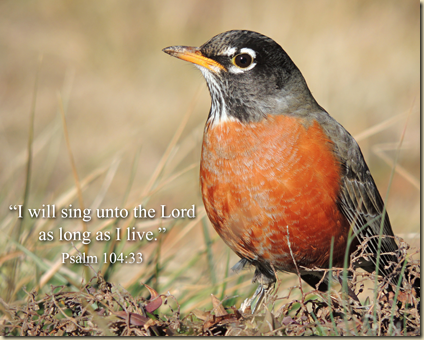
Psalm 104:33

Why are we here? This question has puzzled humanity for almost as long as humanity has existed, but probably never more so than it does in this 21st century. What children are taught in the public schools of our generation and the message we all are eventually subjected to by the world is simple: life is meaningless. We are said to be a mere byproduct of random chance, essentially consisting of little more than rearranged pond scum that will one day die and be forgotten. We’re supposedly no more valuable than a passing breeze or a stick of wood, for they, too, will soon pass away with little notice.

And yet despite Satan’s best efforts to convince us of these things, within each of our hearts is the yearning to do something important, something lasting, with our lives. Few of us never aspired to be an astronaut, the president or a movie star. Perhaps these aspirations were not as eternally significant as we once believed, but they nonetheless reflected a desire to live a purposeful life. Even as adults we pursue romance not only to love, but to be loved; we have children to leave a living part of us behind once we ourselves are gone; we write blog posts because we want to be part of a conversation deeper than next week’s weather forecast. Ultimately, I think one of the greatest fears deep within the heart of every human is that we will one day be forgotten.

As Christians, however, our faith is that we not only can find purpose in life, but that we were actually created with a Divine purpose – specifically, to enjoy an intimate relationship with our Creator and to do so in a way that brings constant glory to His name (Ps. 112:1; Rev. 3:20). And not only were we created with a purpose to fulfill in this life, but we have been given an invitation from God Himself  to spend eternity free from every doubt, fear, and insecurity in heaven with Him. If all of this isn’t enough to keep you motivated, recall that in the meantime we have been commissioned to execute the biggest rescue mission of all time by preaching the Gospel of salvation in all corners of the earth (Mark 16:15).

I’m not trying to give anybody an overinflated sense of importance. There are enough authors, speakers and musicians who make it their priority to build your self-esteem. That’s not my goal here. It’s simply to remind you of a simple yet profound Biblical truth: when He was on the cross, it was out of love for you and me. And through His death and resurrection, we are given hope and meaning much greater than we ever thought possible. So as you live your life, be careful never to allow this realization to slip away. The greatest misery one can experience is in feeling you haven’t a future (1 Cor. 15:19), but if you’re a Christian then the best is yet to come.


Happy Thanksgiving?

“Enter into His gates with thanksgiving, and into His courts with praise: be thankful unto Him, and bless His name.”

          -Psalm 100:4

I’m not against Black Friday. I wasn’t a big proponent of many local stores beginning their sales on Thanksgiving Day, but I did nonetheless serve as chauffeur and cart pusher in-chief to those in my family who had their eyes on some special bargain. Every year I diligently fulfill my assignment, waiting near some tall, brown pallet of merchandise to (hopefully) help a loved one snatch a deal without losing life or limb in the process. Even if you’re able to escape without injury, however, dealing with disgruntled employees and angry shoppers during the holiday season is inevitable.

But even though I’m not against Black Friday per se, I’m certainly not a fan. Just as the Christmas season seems to be more about lights and gifts than the birth of our Savior, it seems Thanksgiving, a day which once upon a time was about gratitude and contentment, is now the greediest day of the year. People were diving over other shoppers, pushing, shoving and yelling – all so they could save $20 on luxury. I understand the need to save money, but is 50% off really worth giving someone a black eye on Thanksgiving? Even though the scene was no less violent and chaotic than I’ve seen in years past, something about the fact that these people weren’t even waiting until the turkey had settled in their stomachs really put a knot in mine.

“And let the peace of God rule in your hearts, to the which also ye are called in one body; and be ye thankful.”

          -Colossians 3:15

Even if you’re someone who stays a mile away from the nearest department store when Thanksgiving rolls around, what’s the first thing you think of when the holiday is mentioned? Traveling to see family you really don’t like? Eating lots of food? Having a few days off work? It seems that very few people have been able to preserve much of what Thanksgiving was originally intended to be: a day to express our gratitude to the Giver of all good things (James 1:17).

So, no, I’m not preaching against Black Friday. As I’ve pointed out, I’ve generally participated in it to some extent myself (although I vowed after Thursday’s events to avoid it completely next year). My conviction is not that we should wait one more week to do our Christmas shopping; it’s that we cannot fail to give God thanks and expect His blessings to continue. So will you join me in seizing today’s opportunity to express our thankfulness to God? In the words of the Psalmist, “it is a good thing to give thanks unto the Lord” (Psalm 92:1).

Magnify the Lord!

Luke 1:42

As a Christian, at the very core of your spiritual walk should be the faith that God has ransomed you from sin by grace through faith in His blood (Ephesians 2:8). You understand that, even though your sin had alienated you from the fellowship of the Lord, the mighty love of God was strong enough to break the yoke of sin from your back and set you free from its bondage (Colossians 1:21). It’s likely you are aware of many answered prayers and see countless evidences every day that God is still on the throne. You are blessed more than anyone could deserve – and you know it.

I won’t say that failure to recognize one’s blessings is never a problem, but generally it is not. On Thanksgiving none of us scratch our head and say, “Hmm…what good thing has God done for me this year?” We’re usually good at spotting the fingerprints of God in our lives; the problem is that we’ve become so accustomed to luxury that we treat God’s goodness like electric lights or running water: most of us have never lived without it, so actually taking time to magnify Him for it often seems unnecessary.

But what does it really mean to magnify God anyway? Does saying a brief, silent prayer of thanks count? I suppose to some extent it does, but truly magnifying the Lord consists of much more than a mere “thank you” is able to accomplish. Consider this excerpt from a sermon by John Piper:

“The word "magnify" can be used in two different senses. It can mean: make something appear greater than it is, as with a microscope or a magnifying glass.
Or it can mean: make something that may seem small or insignificant appear to be as great as it really is. This is what our great telescopes help us begin to do with the magnificent universe which once upon a time spilled over from the brim of God's glory. So there are two kinds of magnifying: microscope magnifying and telescope magnifying. The one makes a small thing look bigger than it is. The other makes a big thing begin to look as big as it really is.

When David says, "I will magnify God with thanksgiving," he does not mean: "I will make a small God look bigger than he is. He means: "I will make a big God begin to look as big as he really is." We are not called to be microscopes, but telescopes.”1

So, then, your calling to magnify God is not fulfilled unless you are actively doing your part to share His glory with others. If your “magnified” version of God is still small enough to fit in your pocket, then all you’ve succeeded at is hiding Him from those who most need His love. To glorify God is to do everything within your power to make His name renowned, known by all nations and trusted by all people. As David wrote in Psalm 22:22, “I will declare Thy name unto my brethren: in the midst of the congregation will I praise Thee.” This is the only way to truly magnify God, especially as we see the day of our Lord’s return approaching, and is the best use of time you will find. So go tell someone about the power and goodness of God. When we each do our part, not only are we being obedient to what Scripture commands us to do, but our hearts will overflow with joy as we begin to comprehend just how great our God truly is.


1 http://www.desiringgod.org/resource-library/sermons/i-will-magnify-god-with-thanksgiving

Daily Mercies

My Commute

As I write this on a Friday night, I’m very aware that the last thing most of you want to hear or think about as you begin your weekend is work. You’re probably either looking forward to spending the next two days with your family doing things you wouldn’t otherwise have time for, or, as in my case, are counting on a restful Saturday and Sunday to end one week and begin another. But as I’ve learned by way of experience over these last several months, living for a two day weekend is a tragic waste of the gift of life. If you wake up every Monday morning with a sigh of reluctance and drag off to work, already wishing it was Friday, then you’ll spend more than 70% of your life unhappy. Lamentations 3:22-23 reminds us that God’s mercies are new every morning – not just on our days off.

One way I’ve been able to realize God’s grace on a daily basis is to make the most of my commute. There are numerous ways to get to work from my house, but I make it a priority to take the scenic route whenever possible. Something about seeing the beauty of an autumn sunrise with worship music playing on my car stereo is able to dissolve that longing to go back to bed and pull the covers over my head. Of course if you live in the city the picture above may be the closest you’ll ever come to a scenic commute, but that’s not what matters; simply find a way to start your day off on the right foot by giving God the opportunity to reveal His love to you afresh.

“Cause me to hear Thy lovingkindness in the morning; for in Thee do I trust: cause me to know the way wherein I should walk; for I lift up my soul unto Thee.”

-Psalm 143:8

Finding 30 minutes to spend in a prayer closet every morning may be next to impossible for some people, especially if getting up at 4 AM barely gets you out the door on time. But the point is not for me to set in stone how you should spend your day with God; it’s for you to identify the often subtle, daily opportunities you may now be overlooking to spend time in prayer and fellowship with your heavenly Father. For me, this means not taking the interstate; for you, it may mean opening up the Bible during your lunch break and feasting on what Job valued even “more than [his] necessary food” (Job 23:12). If your love for God and desire to serve Him is sincere, He will provide and reveal more opportunities to serve Him than you ever realized you had. You just have to keep your eyes open.